| |
Occupational map
This web-site brings together for the first time a complete list of occupations found within the areas of the maritime sector covered by the MSA, together with a description of what each job entails, the qualifications required to perform it effectively and possible career pathways. Any alternative job titles are shown in brackets
To see an overview of the occupations/jobs found in a particular industry, click on the appropriate title below.
If you wish to find out more about the work roles, qualifications required and career pathways, click on the link at the end of the chosen overview section. You can then browse by clicking on the links provided for each occupation/work role.
Commercial Sea Fishing
Marine Leisure
Maritime Search and Rescue
Merchant Navy
Ports and Harbours
Commercial Sea Fishing
| Overview |
|
|
|
|
|
The breadth and level
of occupations in sea fishing vary depending upon the size
of the vessel, type of catch and area in which the vessel
operate. To go to sea on a commercial sea fishing vessel,
individuals must undergo statutory safety training in basic
sea survival, fire fighting and first aid. In addition,
skippers, mates and engineers working on fishing vessels
above a certain length and engine power, or operating in
certain sea areas, are required to hold statutory Maritime
and Coastguard Agency (MCA) Certificates of Competency.
Skipper
Mate
Competent Deckhand (Deckie)
Engineer
Deckie Learner (Apprentice, Trainee Fisherman)
Superintendent Engineer
More
about roles
Qualifications
Required and Career
Pathways in Commercial Sea Fishing
|
|
Marine Leisure
| Overview |
|
|
|
|
|
The Marine Leisure industry
is concerned with those working in occupations related to
using vessels for recreational purposes in the seagoing
and inland sectors of the marine industry, covering;
Design
Naval Architect (Yacht Designer)
Yacht Designer (Boat Designer)
Draughtsman/Draughtwoman (CAD Technician)
Manufacturing
Boat Builder (Yacht Builder, Boat Repairer)
Boat Fitter (Marine Craftsperson)
Marine Engineer
Electrics/Electronics Engineer
Buying and Selling
Yacht Broker (Yacht Agent , Dealer, Distributor
)
Yacht Surveyor ( Marine Surveyor, Small Craft Surveyor )
Watersports Instruction and
Coaching
Watersports manager
Watersports instructor
Marinas and yacht harbours
Marina manager (Yacht Harbour Manager)
Dockmaster (Operations Manager)
Marina operative ( Berthing Assistant , Mooring Assistant
, Yard Assistant )
Crew
Superyacht - A superyacht
can be found on any ocean, on any sea in the world. Superyachts
can be motor or sail and range from 24m up to mini cruiseships.
The number of crew and types of roles and responsibility
will vary depending on the type and size of the superyacht.
On an average superyacht, you will find on board the crew
jobs listed below. Yachts over 60m normally have a crew
of 10 or more
Captain
First officer (Mate)
Engineer
Chef
Chief Steward/Stewardess (Interior Director, Interior Manager,
Hotel Manager )
Deckhand (Deck rating)
Chartering/holidays
- Professional crew and skippers are also needed for yachts
that may be chartered or for flotilla holidays. Roles will
be similar to those on superyachts although roles will normally
be much wider as there may only be 2 crew members.
Flotilla engineer
Flotilla host/hostess
Skipper (Delivery Skipper, Flotilla Skipper, Bareboat Skipper,
Charter Skipper)
More
about roles
Qualifications Required and Career
Pathways in Marine Leisure
|
|
Maritime Search and Rescue
| Overview |
|
|
|
 |
|
Search and Rescue is
the activity of locating and recovering persons either in
distress, potential distress or missing and delivering them
to a place of safety. The UK Government (led by the Department
for Transport) has a statutory responsibility for civilian
Search and Rescue (SAR) within the UK and its aviation and
maritime Search and Rescue Regions, but it delegates the
authority for responding to maritime incidents to HM Coastguard.
HM Coastguard is the on-call emergency organisation that
has overall responsibility for all civilian maritime SAR
within the UK Maritime SAR Region.
The civilian maritime Search and Rescue incl udes the mobilisation,
organisation and tasking of assets (including lifeboats,
SAR helicopters and independent declared facilities) to
respond to persons either in distress at sea, or to persons
at risk of injury or death on the cliffs or shoreline of
the United Kingdom. There are 19 Maritime Rescue Co-ordination
Centres (MRCCs) around the UK Coast, which form a network
of command and control centres for responding to reports
of maritime and coastal distress. These receive incoming
distress calls, alerting the appropriate rescue assets,
and co-ordinating the rescue effort. Among these rescue
assets are 233 lifeboat stations run by the RNLI (with 4,800
lifeboat crew members) which act as a base for storing,
launching and recovering vessels and communicating with
the emergency services.
Lifeboat - Crew
Coxswain (Coxswain trainee)
Helmsman
Mechanic (ILB) (Engineer)
Mechanic (ALB)
Navigator
Crew member
1st aider (Crew member)
Hovercraft commander
More
about roles
Qualifications
Required and Career
Pathways in Maritime Search
and Rescue
|
|
Merchant Navy
| Overview |
|
|
|
 |
|
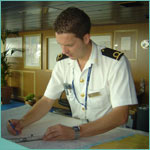
The Merchant Navy is
the common term for the commercial shipping industry. Roles
within the Merchant Navy vary depending on a number of factors,
including size and type of vessel. The range of vessels
includes passenger ferries, container ships, tankers, small
tugs, and cruise ship. Some vessels have a large number
of officers and ratings, whilst others have a very small
number of officers and ratings. This affects the breadth
of responsibilities and seniority of those on board. Furthermore,
there are fewer statutory certification requirements for
officers working on small vessels and on vessels working
in the near coastal area
Officers (Navigation Deck)
Master (Captain)
Chief Officer (Chief Mate)
2nd Officer (2nd Mate)
3rd Officer (3rd Mate)
Cadet (Trainee Officer)
Radio Office (IT officer)
Officers (Engineering)
Chief Engineer Officer
2nd Engineer Officer
3rd Engineer Officer
Junior Engineer
Engineer Cadet
Electro-Technical Officer (ETO)
Electrician
Support Staff/Ratings
Seaman Grade 1 (Able-bodied Seafarer, A.B., Bosun,
Deck Chief Petty Officer, Senior Rating, General Purpose
Rating, General Purpose Seafarer, G.P. )
Seaman Grade 2 (Ordinary Seafarer, O.S., Able-bodied Seafarer,
A.B., General Purpose Rating, General Purpose Seafarer,
G.P.)
Pumpman
Fitter (Engineering Maintenance Fitter)
Motorman (Mechanic)
General hand (Oiler, Wiper)
Cook (Ship's Cook, Chief Cook)
Steward
Trainee Rating (Junior Ordinary Seafarer)
Staff sepcific toTtugs
Tug Master (Tug Skipper)
Tug Engineer
Tug Hand ( Tug G.P, Tug Deckhand)
Hospitality Staff Specific
to Passenger Vessels
Cruise Director
Chief Purser ( Hotel Service Officer, HR Officer)
Shore-based Ship Management
Fleet Operations;
Fleet Director (Commerical Director
Logistics Co-ordination and Training
- Fleet Personnel;
Personnel Manager (Human Resources Manager)
Training Manager (Head of Training)
Personnel Officer
Training Officer
General Operations
Operations Manager (Safety Manager, Quality Manager)
Safety Officer (Quality Officer)
Marine Operations
Marine Superindendent
Marine Technical Assistant
Engineering Operations
Engineering Superindendent (Technical Superintendent)
Assistant Engineering Superindendent (Assistant Technical
Manager)
Engineering Technical Assistant
More
about Roles
Qualifications Required
and Career Pathways
in The Merchant Navy
|
. |
Ports and Harbours
| Overview |
|
|
|
|
|
Ports are places where
vessels carrying cargo and passengers to and from the UK
load and unload. There are approximately 200 commercial
ports in the UK , some employing under ten people and some
over two thousand. Ports are a vital link in the transportation
chain providing facilities to vessels from other UK ports
and ports worldwide.
They vary in purpose and size between:
- major and minor commercial ports;
- small-scale fishing ports;
- passenger/ferry ports;
- inland waterways ports/terminals;
- harbours and marinas.
Occupations and roles within ports
will therefore vary depending upon the type of facilities
they provide and their size. In a large port, job roles
will tend to fall within one of four categories - cargo
operations, marine operations, passenger operations or engineering
operations. However, in a small port or harbour the responsibilities
that individuals have may stretch across two or more of
these categories.
Port Operations
Port operations include passenger, cargo, and marine
operations. Occupational roles could be across the full
range of cargo, passenger and marine functions or they could
be focused in one area, such as Marine Pilotage.
Managing Director (Chief Executive,
Port Director, Port Manager, General Manager)
Port Operations Director (Operations Director, Port Operations
Manager, Port Manager) Security Manager
Ports Facility Security Manager (PFSM, ISPS manager)
Safety Manager (Head of Health and Safety, Health and Safety
Manager, Safety Officer, Safety Advisor, Safety, Health
and Environmental Manager)
Harbour Master (Chief Harbour Master, Haven Master, Marine
Operations Manager)
Deputy Harbour Master (Assistant Harbour Master, Assistant
Marine Operations Manager, Barge Manager, Berthing Master,
Dock Master, Harbour Superintendent , Haven Master Deputy,
Marine Manager, Piermaster, Pilotage Manager)
Hydrogrpahic Surveyor (Senior Hydrographic Surveyor, Base
Surveyor)
Port Operations Manager ( Cargo Operations Manager, Passenger
Operations Manager, Terminal Operations Manager, Wharf Manager,
Stevedoring Superintendent, Operations Superintendent, Assistant
Operations Director, Operations Superintendent, Duty Operations
Manager, Operations Manager)
Marine Pilot
Vessel Traffic Services Officer (VTS Officer, VTS Operative,
Port Control Room Officer, Port Control Officer, Marine
Officer, Marine Operator)
Port Operations Supervisor (Cargo Operations Supervisor,
Marine Operations Supervisor, Passenger Operations Supervisor)
Port Operations team leader (Cargo Operations Team Leader,
Marine Operations Team Leader, Passenger Operations Team
Leader)
Port Operative (Cargo Operative, Marine Operative, Passenger
Operative, General Operative)
Engineering Operations
Director of Engineering (Head of Support Services,
General Manager, Chief Engineer, Port engineer, Head of
engineering)
Port Engineer (Engineering Manager, Engineering Resources
Manager, Marine Engineering Manager, Terminal Engineer)
Civil Engineer (Construction Engineer, Development Engineer,
Civil Foreman)
Engineering Manager (Engineering Superintendent, Plant Engineer
Manager)
Engineering Supervisor (Engineering Foreman, Electrical
Foreman, Maintenance Foreman, Mechanical Foreman)
Technician (Electrician, Engineering Technician, Fitter,
Mechanical Fitter, Maintenance Fitter, General Engineering
Assistant, Third Engineer, Marine Maintainer, Machinist,
Welder, Fabricator, Electronics Technician, Tyre Fitter,
Trailer Fitter)
Maintenance Assistant (Workshop Labourer)
More
about Roles
Qualifications Required
and Career Pathways
in Ports and Harbours
|
|
|




